Showcase Applications
RingKernel includes four comprehensive showcase applications demonstrating GPU-accelerated computing with the actor model. Each showcases different aspects of the framework.
WaveSim - 2D Acoustic Wave Simulation
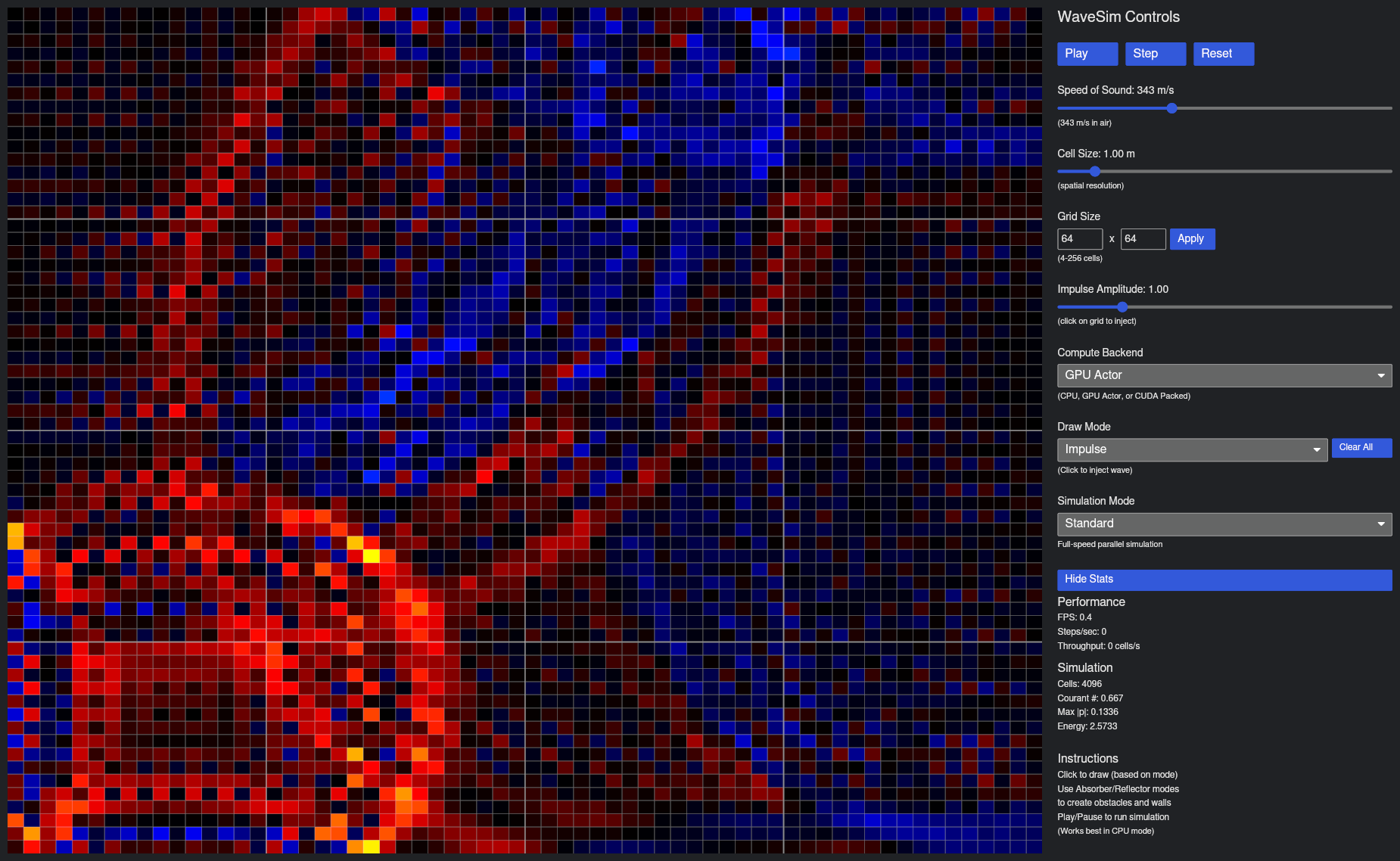
Interactive wave propagation simulator implementing the Finite-Difference Time-Domain (FDTD) method.
Key Features
- Tile-based Actor Model: 16x16 cell tiles as actors with K2K messaging for halo exchange
- Educational Modes: Visualize computing paradigms from 1950s sequential to modern parallel
- Multi-backend: CPU (SoA + SIMD + Rayon) and CUDA
Performance
| Backend | 256x256 | 512x512 |
|---|---|---|
| CPU SimulationGrid | 35,418 steps/s | 7,229 steps/s |
| CUDA Packed | 112,837 steps/s | 71,324 steps/s |
GPU vs CPU speedup: 3.1x at 256x256, 9.9x at 512x512
Run It
cargo run -p ringkernel-wavesim --release
Click anywhere on the canvas to inject wave impulses.
TxMon - Transaction Monitoring
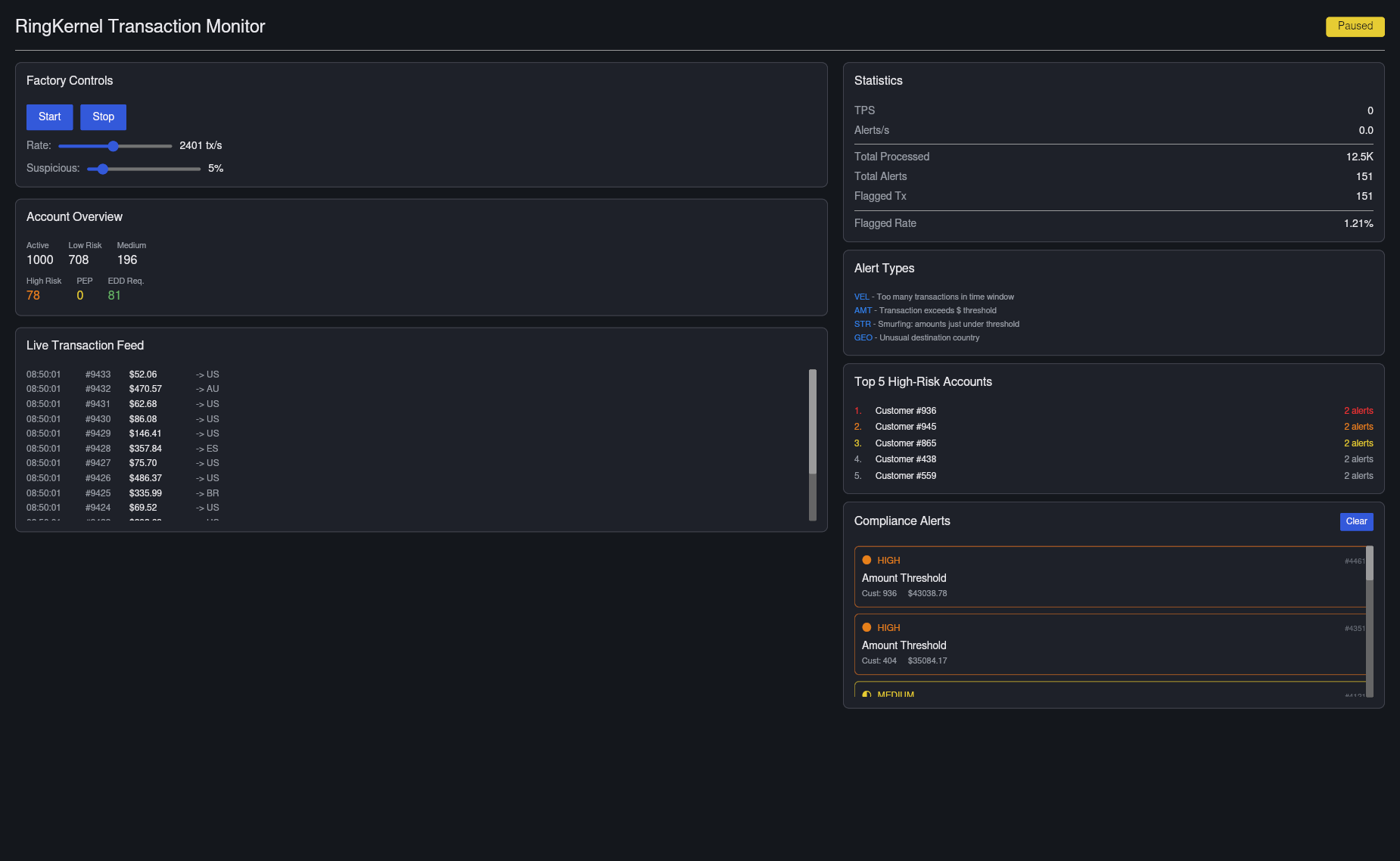
Real-time transaction monitoring for banking/AML compliance scenarios with GPU-accelerated rule evaluation.
Key Features
- Transaction Factory: Configurable synthetic generation with realistic patterns
- Compliance Rules: Velocity breach, amount threshold, structuring detection
- Three GPU Approaches:
- Batch Kernel: Maximum throughput (~93B elem/sec)
- Ring Kernel: Persistent actors with HLC and K2K messaging
- Stencil Kernel: Pattern detection in transaction networks
Performance
| Operation | Throughput |
|---|---|
| Batch Kernel | ~93B elem/sec |
| Pattern Detection | ~15.7M TPS |
Run It
cargo run -p ringkernel-txmon --release
AccNet - Accounting Network Analytics
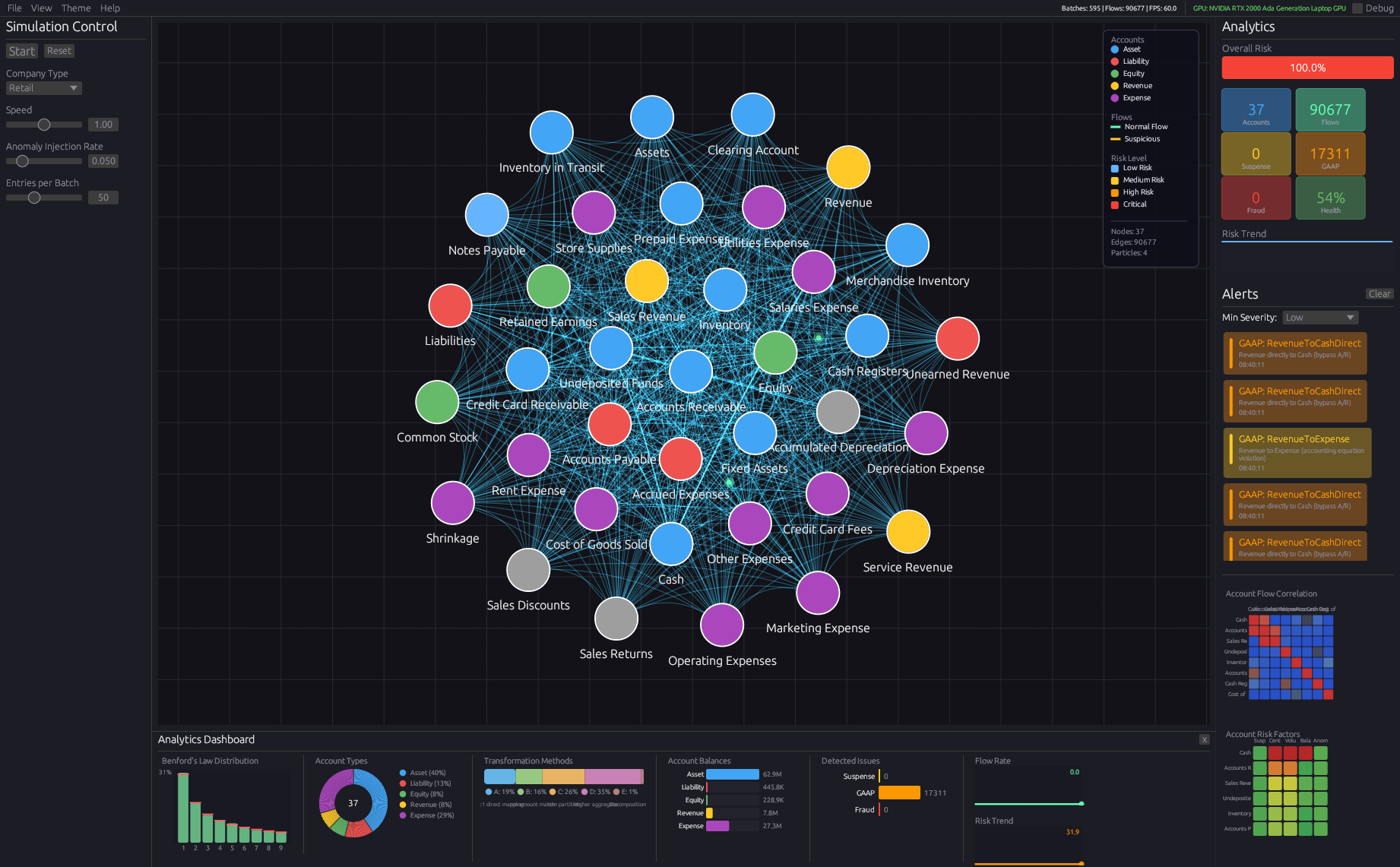
GPU-accelerated accounting network analysis transforming double-entry bookkeeping into graph analytics.
Key Features
- Network Visualization: Interactive graph showing account relationships and money flows
- Fraud Detection: Circular flows, threshold clustering, Benford’s Law violations
- GAAP Compliance: Automated detection of accounting rule violations
- Temporal Analysis: Seasonality, trends, behavioral anomalies
- Industry Chart of Accounts: Pre-built templates for different industries
Industry Templates
| Template | Key Accounts |
|---|---|
| Manufacturing | Raw Materials, WIP, Finished Goods, Direct Labor/Materials/Overhead |
| Professional Services | Unbilled Receivables, WIP-Billable, Client Retainers, Fee Income |
| Financial Services | Trading Securities, Loans Receivable, Customer Deposits, Custody Assets |
GPU Kernels
- Suspense Detection: Identifies suspicious clearing accounts
- GAAP Violation: Checks for improper account pairings
- Benford Analysis: Statistical analysis of first-digit distribution
- PageRank: Network centrality and influence analysis
Architecture
┌─────────────────┐     ┌──────────────────┐     ┌────────────────┐
│   Data Fabric   │────>│  GPU Kernels     │────>│  Visualization │
│ (Synthetic Gen) │     │ (CUDA)           │     │  (egui Canvas) │
└─────────────────┘     └──────────────────┘     └────────────────┘
Run It
# CPU backend
cargo run -p ringkernel-accnet --release

# With CUDA GPU acceleration
cargo run -p ringkernel-accnet --release --features cuda
ProcInt - Process Intelligence
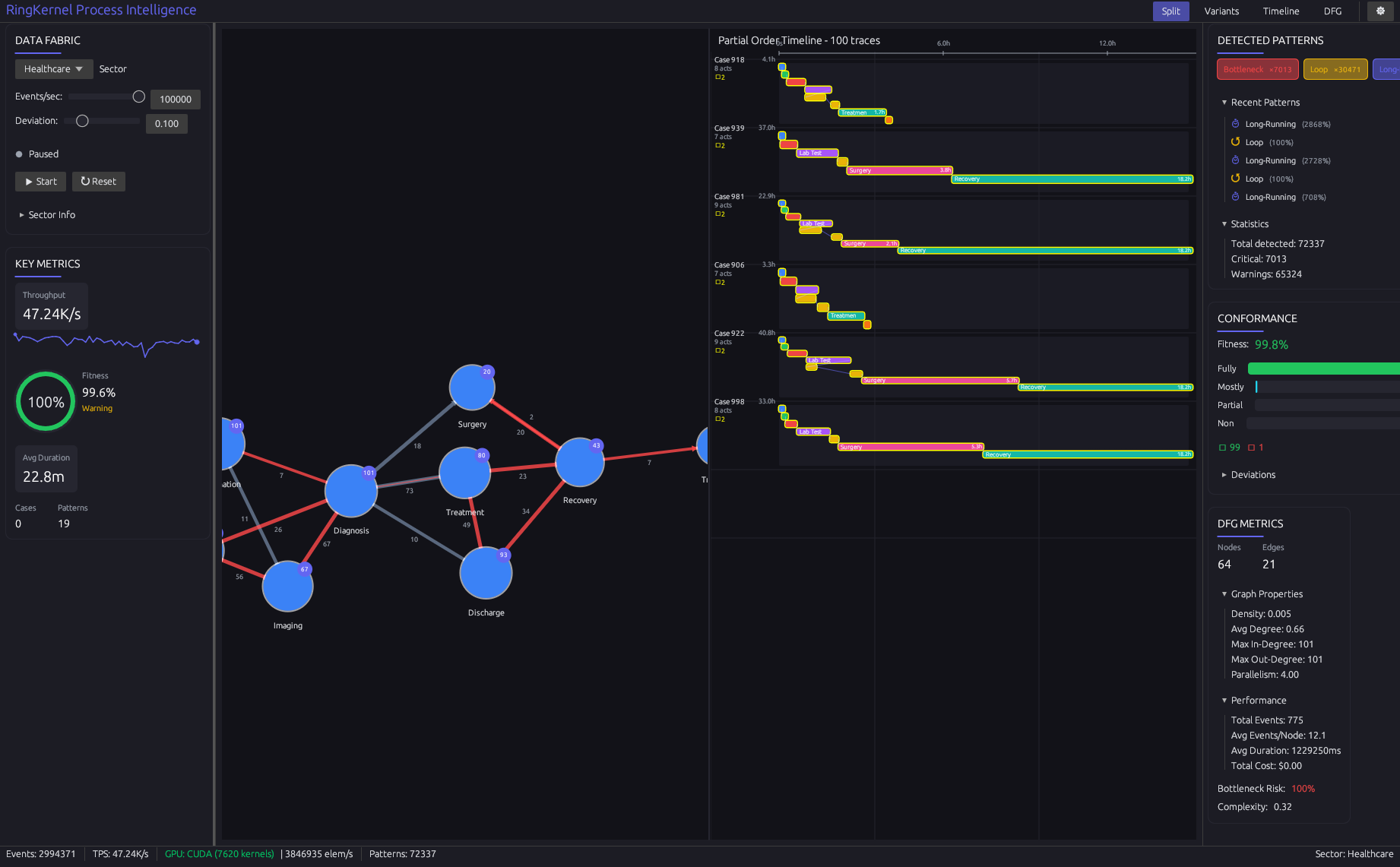
GPU-accelerated process mining for discovering, analyzing, and monitoring business processes from event logs.
Key Features
- DFG Mining: Directly-Follows Graph construction from event streams with GPU acceleration
- Pattern Detection: Bottlenecks, loops, rework, and long-running activities
- Conformance Checking: Fitness and precision metrics against reference models
- Timeline View: Partial order traces with concurrent activity visualization
- Multi-Sector: Healthcare, Manufacturing, Finance, and IT process templates
GPU Kernels
- DFG Construction: Builds directly-follows graph from event stream (batch kernel)
- Pattern Detection: Identifies process patterns like bottlenecks and loops
- Partial Order Derivation: Builds precedence matrix from interval events (stencil kernel)
- Conformance Checking: Validates traces against reference models
Architecture
┌─────────────────┐     ┌──────────────────┐     ┌────────────────┐
│   Data Fabric   │────>│  GPU Kernels     │────>│  Visualization │
│ (Event Stream)  │     │ (DFG/Pattern)    │     │  (egui Canvas) │
└─────────────────┘     └──────────────────┘     └────────────────┘
        │                       │                       │
   Sector Templates      4 Kernel Types           Force-directed
   Anomaly Injection     CPU/CUDA fallback        DFG + Timeline
Performance
| Operation | Throughput |
|---|---|
| DFG Construction | ~47K events/sec |
| Pattern Detection | ~3.8M elements/sec |
Run It
# CPU backend
cargo run -p ringkernel-procint --release

# Run benchmark
cargo run -p ringkernel-procint --bin procint-benchmark --release
Common Patterns Across Showcases
All four applications demonstrate RingKernel’s core capabilities:
| Pattern | WaveSim | TxMon | AccNet | ProcInt |
|---|---|---|---|---|
| GPU Actor Model | Tile actors | Ring kernels | Analysis actors | DFG/Pattern kernels |
| K2K Messaging | Halo exchange | Multi-stage pipeline | Network analysis | Kernel coordination |
| Real-time GUI | iced canvas | iced dashboard | egui graph canvas | egui DFG + Timeline |
| Multi-backend | CPU/CUDA | CPU/CUDA | CPU/CUDA | CPU/CUDA |
| HLC Timestamps | Tile ordering | Transaction ordering | Event ordering | Trace ordering |
| Visualization | 2D pressure | Alerts dashboard | Network graph | DFG + Timeline |
Build All Showcases
# All showcases, CPU only
cargo build -p ringkernel-wavesim -p ringkernel-txmon -p ringkernel-accnet -p ringkernel-procint --release

# With CUDA support
cargo build -p ringkernel-wavesim -p ringkernel-txmon -p ringkernel-accnet -p ringkernel-procint --release --features cuda